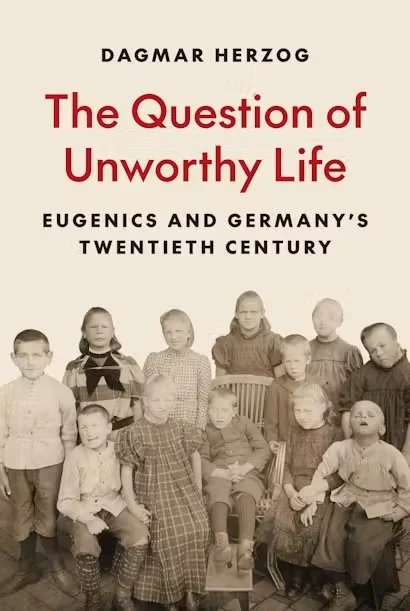
EXPANDING THE BORDERS OF HUMANITY
Udi Greenberg
History and Theory 65, no. 2 (2026)
Review of Dagmar Herzog, The Question of Unworthy Life: Eugenics and Germany's Twentieth Century (Princeton University Press, 2024)
In The Question of Unworthy Life: Eugenics and Germany's Twentieth Century, historian Dagmar Herzog explores one of the most remarkable transformations in European approaches to human life: the rise and fall of eugenics. In particular, she explores how Germans debated the treatment of people with intellectual disabilities: in the late nineteenth century, doctors, psychiatrists, and Christian caretakers came to equate productivity with worth. They defined people with disabilities as “unworthy” of life, which legitimized mass atrocities such as sterilization and killing under the Nazis and continued to shape their mistreatment during the postwar era. From the 1970s onward, however, a new cohort of activists challenged the eugenicist mindset and launched new campaigns to endow cognitively disabled people with respect and rights. This review essay assesses Herzog's claim that this shift was powered by the activists’ anti-fascist confrontation with the Nazi past. It argues that their success should also be understood as the product of a broader process: the decline of European efforts to mold “productive” bodies and increase birthrates. Future histories of eugenics’ decline should therefore complement Herzog's illuminative perspective with explaining how advocacy was ironically empowered by growing apathy about productivity.